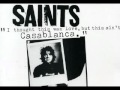
"A part of me felt Like Elvis, it was not a large part." Jerry Jerry
Jerry ended his recording career and his contract with Aquarius with a 1997 solo album named The Sound and the Jerry. It's truth in packaging, as the record is the sound of pure Jerry, sans his Sons of Rhythm Orchestra.
While the loss is palpable - Jerry shines with co-writer and a full band - there are a slew of witty moments herein and some nice raw guitar, as on "I, Showbiz".
Jerry's never less then entertaining and fans of his early work will find plenty to grin about here. On this album, Jerry (and his percussionist, Tino Izzo) sounds a bit like an urbane Mojo Nixon, melding cutting wit and minimal instrumentation to a blues-rockabilly-country-folk foundation to great effect on tracks like "Balloons" or "Eyes on the Road".
MRML Readers weigh in with a comment: What do you think of Jerry's solo sound?
"Everybody's gotta believe in something, no matter how stupid, destructive or wrong; case in point, Aleister Crowley."
Jerry Jerry
Aquarius Records re-released Jerry2
& SRO's masterwork, Battle Hymn of the Apartment, in 1990 but it went nowhere. So the group hunkered down and chartered a new course for 1992's Don't Mind If I Do.
The Third-Album Mellow-Out is in full-effect here, as Jerry's manifests his Sinatra-aspiratons (see "Grandiose"or "Skin") and his Nashville Sound affections, as heard on the lone single, "Jimmy Reeves".
Amidst the mellower material, there is also a passel of sarcastic up-tempo songs like "The Ballad of Jon Card" (celebrating the former D.O.A. and S.N.F.U. drummer), "How Can People be So Wrong", "Banner Day and the witty country novelty song, "No Ass Tattoos in Heaven".
So, while this is by no means a jazz record, it might be the closest MRML ever gets to posting one.
Now I grant you that I instantly rejected this album back '92 but I have since found it a charming record that bears repeat listenings. Give it a listen and let us know what you think.
MRML Readers weigh in with a comment: What do you think of Jerry's more mature sound?
"Turn around and be some one better; time permitting and shit." Jerry Jerry
In 1986 Jerry Jerry and his ever-changing Sons of Rhythm Orchestra emigrated from Edmonton, Alberta to Montreal, Quebec. The band moved from Og Records, to the Doughboys' 1st home, Piepline Records before settling on their final label, Aquarius Records (home of great Can-Crap from April Wine to Corey Hart to Sum 41).
For Battle Hymn of the Apartment (1987) Jerry found his definitive band, with Paul Soulodre (guitar,vocals) George Wall (guitar,vocals) Duke Bronfman (drum, vocals), future Asexual Blake Cheetah (bass), not to mention backing horns, keyboard and a vocal trio.
As the credits suggest there are layers and layers of vocals here and all those voices underpin Jerry's role as the leader of a strange midnight choir. For proof of how this ensemble feeds Jerry's "Pusher for Jesus" personae - give this track a listen.
On this album Jerry Jerry really claims his voice and that voice is a whiskey-and-cigarette soaked baritone that fires off venomous sermons. The Sons of Rhythm Orchestra are a super-tight unit that propel Jerry, turning his gospel and R n' B pastiches into torn flesh and dripping blood rockers.
Tracklist
A1 Runaway Lane
A2 Bad Luck At Tulane
A3 Pushin' For Jesus
A4 Free Love
A5 She's Been Used
A6 Hurtin' Her Won't Make You A Man
A7 The Mexican In Me
B1 The Hard Way
B2 In The Hands Of The Lord
B3 Wazoo
B4 Mistaken
B5 Downhearted
B6 The Drift
MRML Readers weigh in with a comment: is this Jerry's master work?
"Jerry Jerry wasn't a serious band at the time it started, either. It was what we called a "fuck band". It took four or five years before I considered myself to be a performer."
Jerry Jerry
At the height of Canada’s eighties stomping garage-rock revival, spearheaded by Og Records (see here), along swaggered this hard-drinking, testifier, Jerry Jerry, (born Jerry Woods) and his seven piece band, the Sons of Rhythm Orchestra.
"Canadian city boy thinks he's a hillbilly preacher sings late '60s Texas acid rock." is how Jerry Jerry's debut album Road Gore: The Band That Drank Too Much (1985) was once described. And that just scratches the surface. The tempos are speedy, the lyrics sarcastic and the band chops up elements of blues, country, gospel, rockabilly surf and punk rock to make a thick n' chunky stew. The resulting sound is roots-rockin' cow-punk a little like their Edmonton, Alberta brethren Jr. Gone Wild (and even a little like really early k.d. lang). However, there's not much R.E.M. style jangle in these boys spurs and you can bet your ass that Jerry would make short work out of Micheal Stipe should they ever meet.
In that spirit, here's Jerry's brilliant anti-socialism screed, "Bad Idea". While still-gelling Road Gore may not be Jerry's strongest album, this song stands as his greatest achievement - no wonder it's track one, side one of the whole It Came From Canada compilation series. The lyrics are both humorous and deadly-serious. Jerry uses a stinging guitar line as his soapbox to condemn the evils of Big Government (Alberta is Canada's Texas) while the whole band offers full choral support. Eventually Jerry's righteous fury builds to an explosive triple-time ending. (Studio version here)
Tracklist
A1 Gospel Surfer
A2 Rhythm Crazy
A3 Color TV
A4 Baby's On Fire
A5 Livin' On Top
A6 Hell And Back
A7 Daddy Was A Peacock
B1 Happy Nun
B2 Bad Idea
B3 Rancher King
B4 Dumb Love
B5 You Make Me Blue
B6 Judgement Date
This MRML-exclusive "edition" of the hopelessly out-of-print Road Gore has two bonus tracks, "Radical Look" and "Yap Yap", culled from the It Came From Canada series.
MRML readers weigh in with a comment: What do you make of Jerry Jerry's Gospel-punk?
So, Tommy Ramone, the last of the original Ramones is dead. Sad, fucking sad. Tommy was one of the architects behind the the band, supposedly only taking the drum stool after auditions failed to secure anyone capable of understanding what the band was doing. When the band lost its way in a fog of big-name producers in the early 80's, it was Tommy who took the producers helm for the comeback album "Too Tough To Die and righted the Good Ship Ramone.
Here's an artifact of the Tommy-era. The sound is dirty as hell but it's still amazing that this not only exists but how how clearly it demonstrates the band's focus well before the recording of the first album.
The fact that this was filmed says that a lot of people, artistic director Arturo Vega not least among them, knew that something earth-shaking was afoot in NYC.
Ramones-maniacs:
What do you make of this super-early Ramones performance?
MRML is a blog about the devestating effects of culture: music, politics, comics plus etc. blah blah blah. At times MRML will post fine, unpurchasable three-chord obscurica (punk, pop-punk, new wave, mod, power-pop, gospel, reggae, hardcore, rockabilly, folk, country...whatever.) - - - - - - "The otherwise unavailable files in this blog are posted for a limited time and are intended for educational, non-commercial use. These files were transcribed from what are believed to be out-of-print sources. If you are aware of any of these items being readily available from commercial sources, or if any of these files infringe upon rights that you hold, please notify us so that we can quickly remove the referenced items immediately." - - - SUPPORT THE ARTISTS - BUY MUSIC!
If you have any questions or music to donate you can contact me at musicruinedmylife (at) gmail (dot) com
Re: Re-Ups
MRML does not plan to restore all of the content lost in The Great Mediafire Gutting of 2012. Polite requests may be made in the appropriate section, regular commenters will get priority.


.png)